• Link to Instagram
  • Link to Xing
  • Link to LinkedIn
  • Link to Youtube
  • Career
  • Media library
  • Deutsch Deutsch German de
  • English English English en
Wir überarbeiten unsere Website – Ihre Meinung hilft uns (4 Minuten Umfrage)   → Zur Umfrage • Wir überarbeiten unsere Website – Ihre Meinung hilft uns (4 Minuten Umfrage)   → Zur Umfrage • Wir überarbeiten unsere Website – Ihre Meinung hilft uns (4 Minuten Umfrage)   → Zur Umfrage
  • About us
    • Our mandate
    • Our guidelines
    • Organisation
    • Management
    • Certificates/ Reports
    • Environmental responsibility
  • Interim storage
    • Interim storage – General information
    • Frequently Asked Questions (FAQ)
    • The waste
  • Sites
  • Projects
    • Extended interim storage
    • Research Programme
    • Return of reprocessed radioactive waste
    • Research reactors
  • Click to open the search input field Click to open the search input field Search
  • Menu Menu

OBSERVE – Dose rate and temperature measurement programme

Subject matter:OBSERVE
» Dose rate and temperature measurement programme on loaded casks
» Comparison of calculated expected values with measurement values on selected casks at different points in time during storage
Project partners:WTI
Period:Phase I (feasibility study): completed
II (measurement programme): in planning
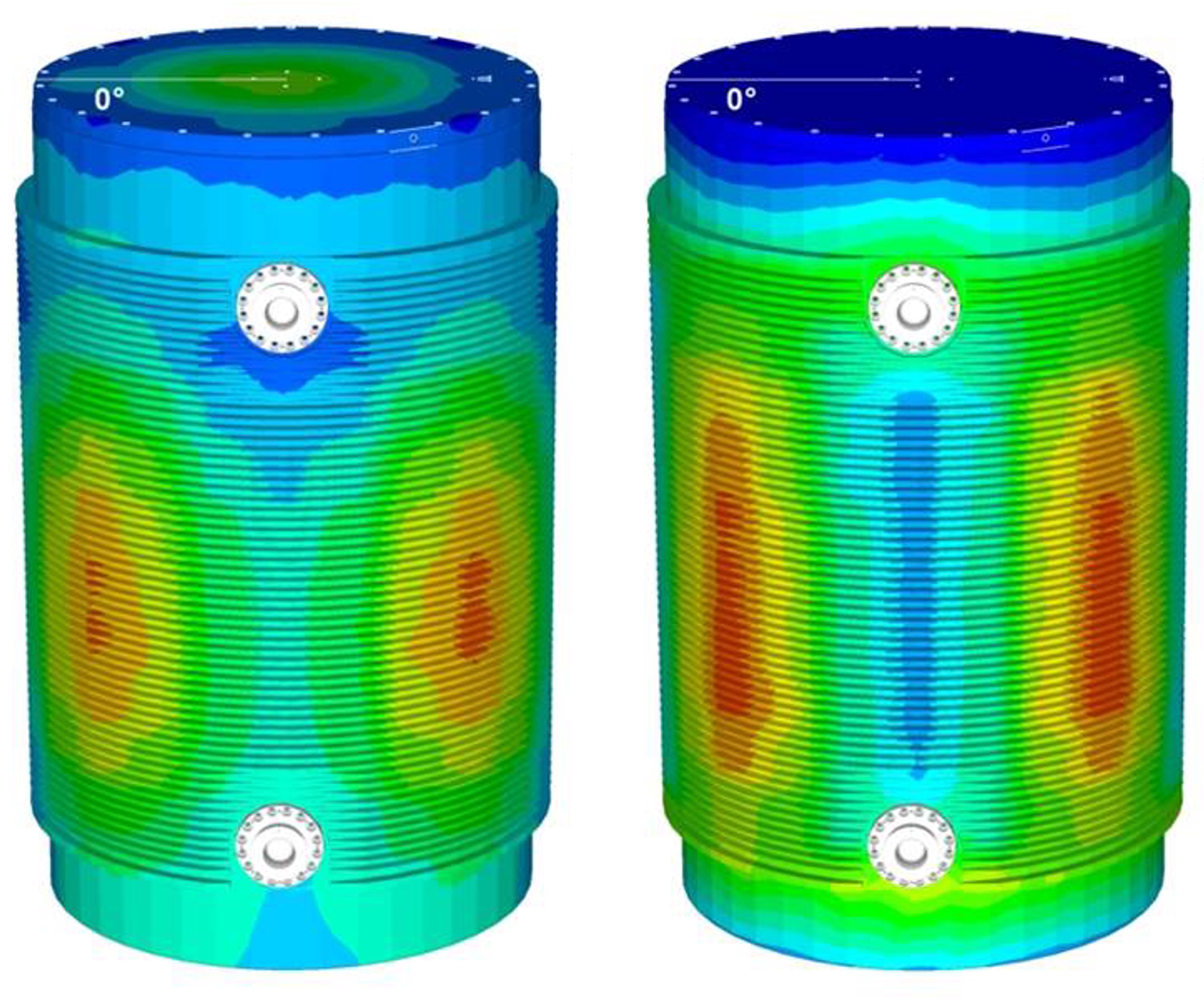
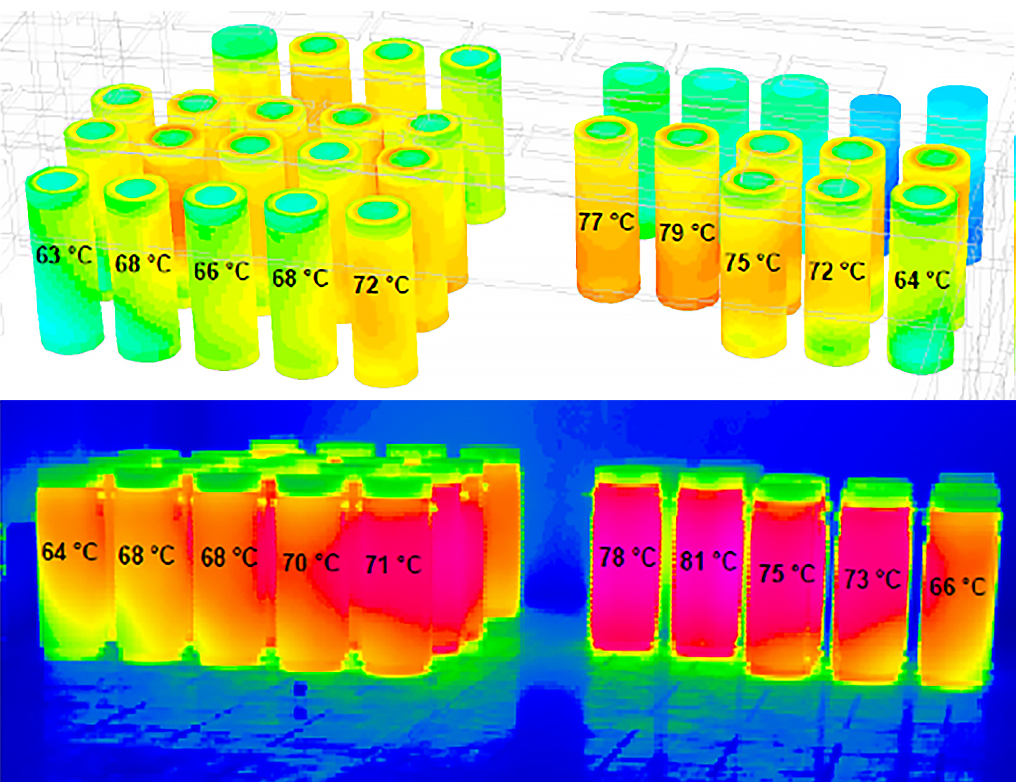
The distribution of dose rate and temperature on the cask surface depends on the arrangement and characteristics of the radioactive inventory and cask components (see Figure 6 and Figure 7).

Measurements are routinely taken before casks are placed in storage to confirm compliance with the applicable dose rate and temperature limits for storage in the respective storage facility. These measurements are carried out at representative measuring points specifically defined for each cask type in order to obtain reliable information about the mean value or to find maximum values.

Figure 6: Distribution of dose rates on the surface of a CASTOR® cask (left: neutron dose rate, right: gamma dose rate)

Figure 7: Comparison of calculated and measured maximum cask temperatures in an interim storage facility (left: CFD calculation, right: thermography)

Activity and thus heat generation both decrease during storage as a result of the radioactive decay of the inventory. Likewise, there are temperature-dependent and radiation-induced changes in the properties of the materials used (for example, thermal expansion, density changes and radiolysis of the moderator material), which in turn effect shielding and heat dissipation.

The planned dose rate and temperature measurement programme OBSERVE aims to measure the entire surface of selected casks intermittently over a long period of time. Measurements provide immediate and integral information on the ageing behaviour of the casks or the inventory. The measured dose rate and temperature curves must be compared with the predicted values for this purpose. These comparisons and the respective distribution can be used to draw conclusions about actual shielding and heat dissipation properties. If the measured values are within the expected range, this confirms that no unexpected changes have occurred and that the ageing behaviour has been correctly assessed. In this way the measurement programmes can make an active contribution to ageing management.

In the first stage of the project, sensitivity studies were carried out to check the extent to which dose rate/temperature measurements are suitable for drawing conclusions about the condition of cask components and the inventory. The sensitivity analyses have shown that, to a certain extent, both changes in the fuel arrangement and gaps in the neutron shielding can be detected by close-meshed dose rate measurements on the cladding surface. It can therefore already be said that the OBSERVE measurement programme is in principle suitable for supplementing existing ageing management measures and for assessing the condition of the casks by measurement. The results of the sensitivity analyses will be used to determine the requirements for carrying out the measurements (equipment, measurement grid, measuring period) and to develop a corresponding measurement programme.
Publications

  • OBSERVE Zwischenbericht zum Abschluss der ersten Projektphase, Dr. Sven Tittelbach, Ralf Schneider‐Eickhoff, Dr. Maik Stuke und Dr. Jörn Becker, DOI 10.69152/OBSERVE/2025, 2025.
  • OBSERVE – A comprehensive dose rate and temperature measurement programme for long-term interim storage, J. H. Klingen, R. Schneider-Eickhoff, Dr. N. Böning, Dr. J. Becker, Third interdisciplinary research symposium on the safety of nuclear disposal practices, safeND2025-5, 17–19 September 2025, Berlin, Germany, DOI 10.5194/safend2025-5, 2025.
  • Operational Experience with Transport and Storage Casks for Spent Nuclear Fuel – Comparison of Calculated Dose Rates with Measured Dose Rates, S. Tittelbach, D. Amian, J. Klingen, M. Nekipelov, R. Schneider-Eickhoff, M. Stuke, Nuclear Science and Engineering, pp. 1 – 18, DOI 10.1080/00295639.2026.2619307, 2026.
  • OBSERVE – Entwicklung eines automatisierten Dosisleistungsmess-Systems, Jan Klingen, Dr. Nadine Böning, Dr. Sven Tittelbach, Ralf Schneider-Eickhoff, Proceedings 4. Fachworkshop Zwischenlagerung, BGZ Gesellschaft für Zwischenlagerung, DOI 10.69152/BGZFachworkshop/proceedings/2025, 2025.
  • Nutzung von Betriebserfahrungen mit beladenen CASTOR®‐Behältern zur rechnerischen Vorhersage der Behältermanteldosisleistung, Dr. Sven Tittelbach, Jan Henrik Klingen, Ralf‐Schneider‐Eickhoff, Dr. Maik Stuke, Dominik Amian, Dr. Michael Nekipelov, Proceedings 4. Fachworkshop Zwischenlagerung, BGZ Gesellschaft für Zwischenlagerung, DOI 10.69152/BGZFachworkshop/proceedings/2025, 2025.
To top All research activities
  • Research activities of the BGZ

  • Research in the field of casks
  • DPOPT
  • MLIFT
  • MSHIFT
  • MSim
  • MSTOR
  • OBSERVE

  • Research in the field of inventories
  • Bend & Break
  • DCS-Monitor II
  • EPRI-ESCP Decay Heat Task Group
  • EPRI-ESCP Dose Modeling Task Group
  • EPRI-ESCP Thermal Modeling Benchmark
  • HYDAX
  • LAGER
  • LEDA
  • MuTomCa
  • SCIP IV / V
  • SpizWurZ
  • SKELETON
  • VisCas

  • Research in the field of interim storage buildings
  • ZuMoBau-ZL

Headquarters

BGZ Gesellschaft für Zwischenlagerung mbH
Frohnhauser Straße 50
45127 Essen, Germany

Phone +49 201 2796-0
Email info@bgz.de

Home | Press | Imprint | Privacy | Compliance

Berlin Office

BGZ Gesellschaft für Zwischenlagerung mbH
Wilhelmstraße 118
10963 Berlin

Phone +49 30 253 592 100
Email info@bgz.de

ecozoom certificate: all website emissions have been compensated.
Scroll to top