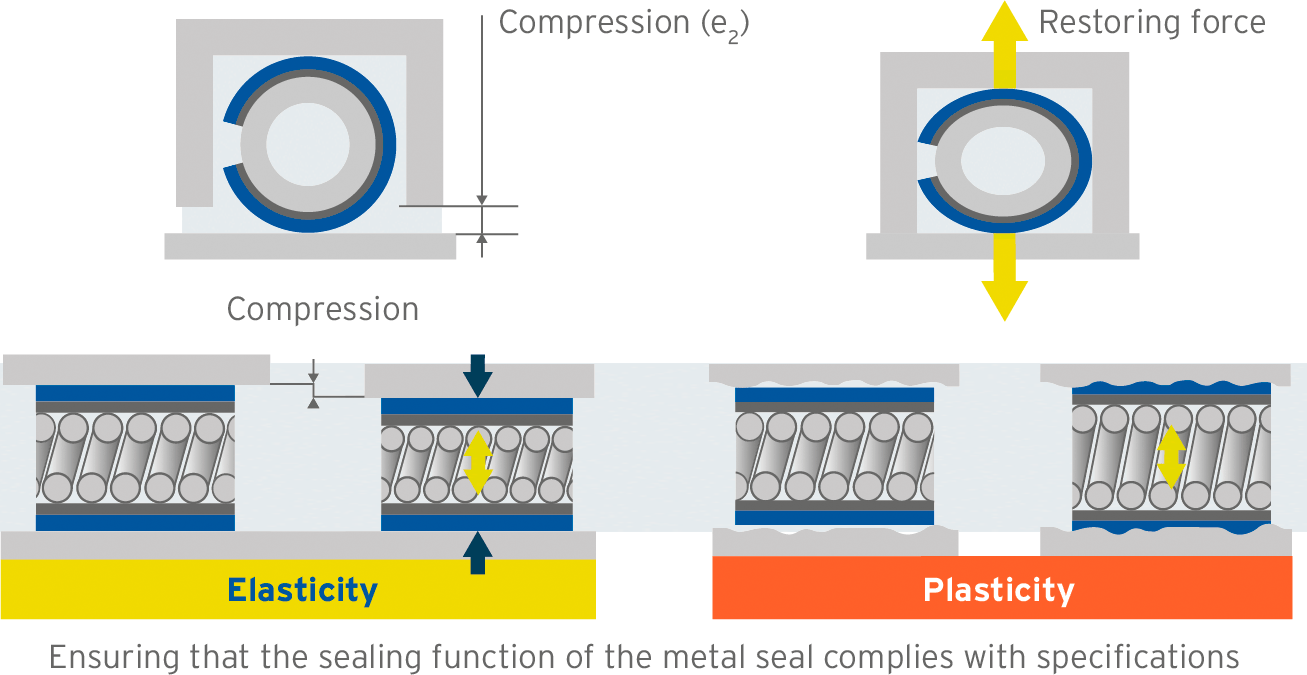
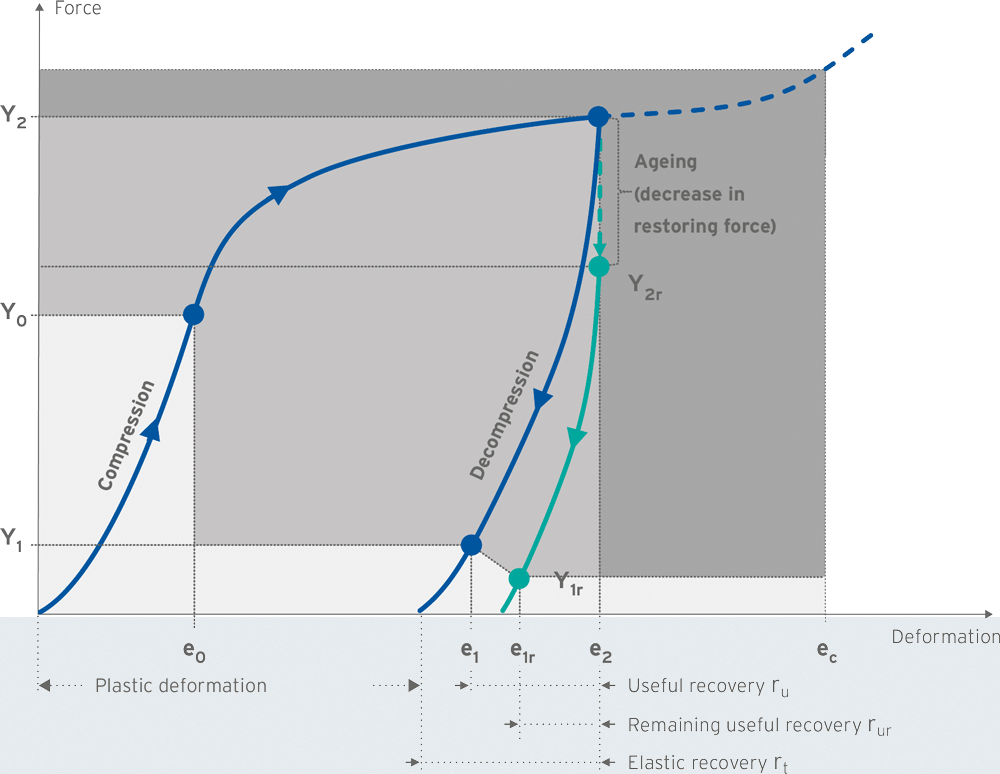
During initial compression of the metal seal, a force-deformation curve is obtained as shown in Figure 4. At deformation e0, the required tightness is achieved for the first time, but only at deformation e2 is the seal at its operating point. The seal is compressed to the operating point thanks to the depth of the groove in which the seal is inserted in the lid, as the difference between the groove depth and the torus diameter of the seal corresponds exactly to the optimum compression e2.
If the seal is decompressed as a result of external loads, i.e. if a gap emerges between the lid and the mating surface, the required tightness is maintained until e1 is reached. The permissible gap between the sealing surface and the lid corresponds to the useful elastic recovery ru (see Figure 4). In particular, this parameter and the associated force Y1 are essential for evaluating the behaviour of the metal seal under operating and accident conditions.
In the assembly state, mechanical stress and temperature exposure lead to creep processes in the metal seal. These become noticeable in the form of relaxation. As shown in Figure 4, relaxation decreases the restoring force at the operating point to Y2r with unchanged deformation. Although the minimum force required to maintain the specified tightness Y1r decreases upon decompression, the deformation e1r also decreases accordingly, so that the remaining useful recovery rur for an aged seal decreases considerably compared to the assembly state.
Knowledge of the characteristic values Y1r and rur of an aged seal is therefore of great importance to reliably evaluate the long-term behaviour of the metal seals. In particular, the remaining useful recovery rur is a measure for assessing the robustness of the sealing barrier, i.e. the extent to which the seal is able to maintain the required tightness even under external mechanical influences.