• Link to Instagram
  • Link to Xing
  • Link to LinkedIn
  • Link to Youtube
  • Career
  • Media library
  • Deutsch Deutsch German de
  • English English English en
Wir überarbeiten unsere Website – Ihre Meinung hilft uns (4 Minuten Umfrage)   → Zur Umfrage • Wir überarbeiten unsere Website – Ihre Meinung hilft uns (4 Minuten Umfrage)   → Zur Umfrage • Wir überarbeiten unsere Website – Ihre Meinung hilft uns (4 Minuten Umfrage)   → Zur Umfrage
  • About us
    • Our mandate
    • Our guidelines
    • Organisation
    • Management
    • Certificates/ Reports
    • Environmental responsibility
  • Interim storage
    • Interim storage – General information
    • Frequently Asked Questions (FAQ)
    • The waste
  • Sites
  • Projects
    • Extended interim storage
    • Research Programme
    • Return of reprocessed radioactive waste
    • Research reactors
  • Click to open the search input field Click to open the search input field Search
  • Menu Menu


DPOPT – Optimisation of the pressure switch

Subject matter:DPOPT
» Optimisation of the pressure switch
» Qualification of a production-optimised component
Project partners:» GNS (cask manufacturer, Germany)
» HBM pressure switch manufacturer, Germany)
Project period:2021 to 2029 including BAM qualification
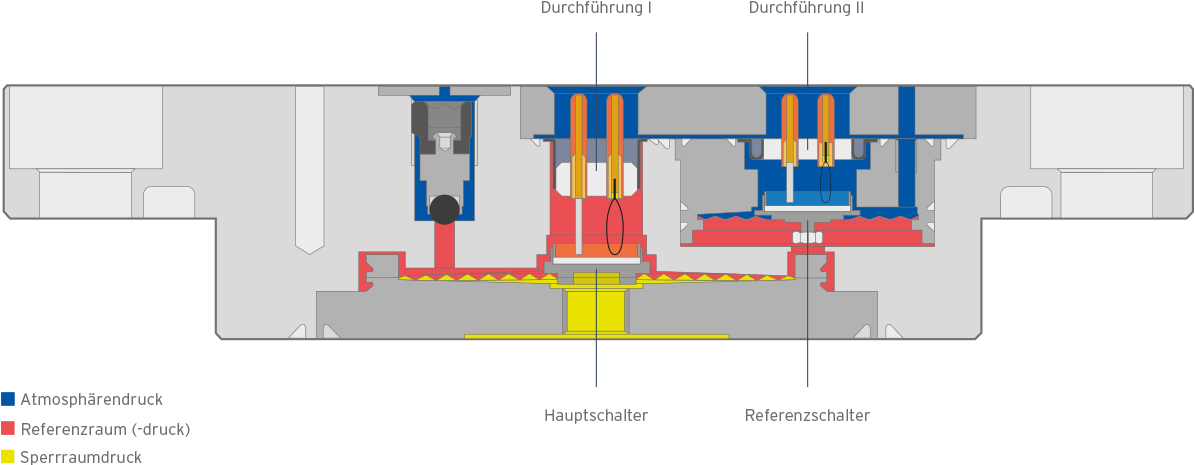
The sealing function of the double-lid sealing system is monitored by means of a pressure switch mounted in the outer sealing barrier of the double-lid sealing system and connected to the inter-lid space.

The pressure switch in turn is connected to the cask monitoring system. If, during storage, the pressure in the inter-lid space drops below the pressure level in the reference chamber of the pressure switch due to a defect in one of the two barriers, the contact of the main switch is opened and the cask monitoring system reports “Inter-lid pressure low”.

Figure 8:
Basic design of the pressure switch

The pressure switch is a complex component (see Figure 8 and Figure 9), which is manufactured to high quality standards. However, random defects cannot be completely ruled out. The pressure switch therefore has a self-monitoring function in the form of an additional switch for the reference chamber. If pressure in the reference chamber drops below the specified switching pressure due to a pressure switch defect, the corresponding contact is opened and the cask monitoring system reports “Reference chamber pressure low”.

Figure 9:
Pressure switch – top view without cover plate I

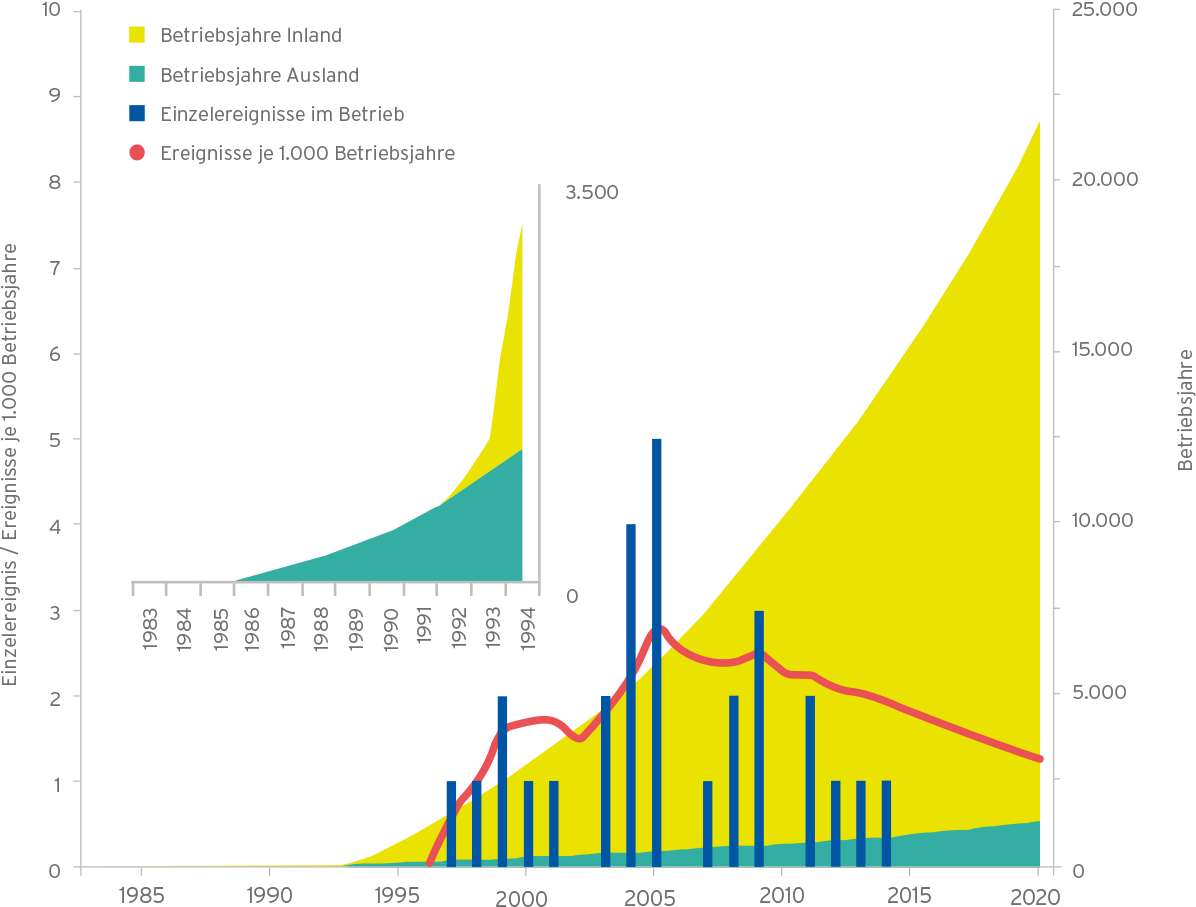
There have only been a very limited number of defects – so-called pressure switch events – in the more than 1,400 pressure switches that are installed worldwide. Some of these 1,400 switches have been in operation for more than 30 years, adding up to a total operating time of more than 20,000 years. The failure probability of a pressure switch is in the range of less than ten 6 per year.

Figure 10:
Comparison of years of operation and pressure switch events

Figure 10 shows that pressure switch events do not correlate with the total number of operating years. It can therefore be assumed that events occur randomly, and it cannot be deduced from their distribution over time that a systematic increase in failures is associated with extended interim storage. The decrease in the frequency of failures is also related to incorporation of the lessons learned during operation or during failure evaluation into the handling of the pressure switches.

Specific evaluations of pressure switch events show that the vast majority of events were due to leakage at the feedthroughs of the contact pins. This resulted in a pressure drop in the reference chamber but not in a failure of the containment function of the lid system. However, BGZ is working with GNS to optimise the pressure switch for interim storage purposes. Preliminary studies by the manufacturer HBM and GNS show that using glass feedthroughs instead of the ceramic feedthroughs previously used is a promising solution to the problem, as glass feedthroughs do not require additional soldering material.

The DPOPT research programme will subject the new contact feedthrough design to several tests covering operating conditions. The contact pins will be subjected to different mechanical stresses, which are considered to be the cause of the previous defects. These include pure weight loads and the simulation of repeated plugging and unplugging. The new switch will also be subjected to thermal loads to demonstrate that the glass feedthroughs are suitable for the entire temperature range envisaged. Load tests will be followed by helium leak tests in which the specified maximum leak rate must not be exceeded. After successful completion of the internal qualification, a qualification of the glass feedthrough is planned at BAM in order to be able to use the optimised design in the future production of pressure switches.
Publications

  • DPOPT – Optimierung des Druckschalters, Jan Klingen, Dr. Nadine Böning, Ralf Schneider‐Eickhoff, Proceedings 4. Fachworkshop Zwischenlagerung, BGZ Gesellschaft für Zwischenlagerung, DOI 10.69152/BGZFachworkshop/proceedings/2025, 2025.
To top All research activities
  • Research activities of the BGZ

  • Research in the field of casks
  • DPOPT
  • MLIFT
  • MSHIFT
  • MSim
  • MSTOR
  • OBSERVE

  • Research in the field of inventories
  • Bend & Break
  • DCS-Monitor II
  • EPRI-ESCP Decay Heat Task Group
  • EPRI-ESCP Dose Modeling Task Group
  • EPRI-ESCP Thermal Modeling Benchmark
  • HYDAX
  • LAGER
  • LEDA
  • MuTomCa
  • SCIP IV / V
  • SpizWurZ
  • SKELETON
  • VisCas

  • Research in the field of interim storage buildings
  • ZuMoBau-ZL

Headquarters

BGZ Gesellschaft für Zwischenlagerung mbH
Frohnhauser Straße 50
45127 Essen, Germany

Phone +49 201 2796-0
Email info@bgz.de

Home | Press | Imprint | Privacy | Compliance

Berlin Office

BGZ Gesellschaft für Zwischenlagerung mbH
Wilhelmstraße 118
10963 Berlin

Phone +49 30 253 592 100
Email info@bgz.de

ecozoom certificate: all website emissions have been compensated.
Scroll to top