The BGZ research mission

The strategy for the responsible and safe disposal of spent nuclear fuel and heat-generating radioactive waste is stipulated in the German government’s National Waste Management Programme. BGZ Gesellschaft für Zwischenlagerung mbH’s mandate in the national waste management strategy is derived from the Act on the Reorganisation of Responsibility in Nuclear Waste Management.
Abbildung 1: Vereinfachte Darstellung des zeitlichen Ablaufs von der ersten Behälterbeladung bis zur Einlagerung in ein Endlager

BGZ is a company organised in private legal form that is wholly owned by the Federal Government. BGZ was founded to ensure the reliable and safe operation of interim storage facilities for low, intermediate and high-level radioactive waste. Since 1 January 2019, the interim storage facilities for high-level radioactive waste have included not only the Ahaus and Gorleben interim fuel storage facilities but also the Biblis, Brokdorf, Grafenrheinfeld, Grohnde, Gundremmingen, Isar, Krümmel, Lingen, Neckarwestheim, Philippsburg and Unterweser sites1. High-level radioactive waste is stored at interim facilities before being finally placed in a repository. The process of searching for and selecting a site for a repository for high-level radioactive waste is far from complete and forecasts are difficult. Irrespective of this, the interim storage periods of up to 40 years assumed and approved to date will not be sufficient to cover the period until a repository for spent nuclear fuel and heat-generating radioactive waste is commissioned and the storage facilities are completely cleared (see Figure 1). As the operator and licence holder, BGZ is required to demonstrate that the transport and storage casks are placed in a safe manner and that the safety objectives for extended interim storage are met, irrespective of the duration of such storage and in accordance with the state of the art in science and technology.

The research programme identifies the research that is required and provides an overview of BGZ’s research strategy and activities.

Figure 1 (on the left): Simplified timeline from the first cask loading through to storage of the casks in a repository

Figure 1: Simplified timeline from the first cask loading through to storage of the casks in a repository
Development of the research programme

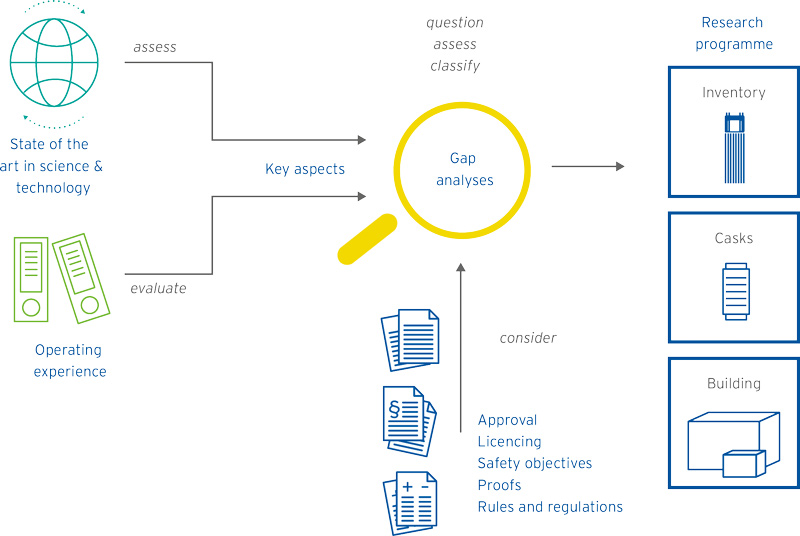
The development of the research programme follows a holistic approach to safety objectives. In this context, the safety proofs on which the storage licences and package design approvals are based are systematically and critically questioned with regard to extended interim storage.

The research programme also draws on ongoing operational experience with storage buildings, casks and inventories. International exchange and the review of current research findings that define the state of the art in science and technology also play an important role in determining the research needs with respect to extended interim storage (see Figure 2). Effects and possible countermeasures are always key factors to be taken into account when assessing the need for research. The underlying concept of dry interim storage and the associated functions of the casks, the inventory and the storage building, must also be included. The aim is to identify any need for action at an early stage in order to be able to use the remaining time until the application is submitted for corresponding research programmes and thus open up additional options for action if necessary.

Abbildung 1: Vereinfachte Darstellung des zeitlichen Ablaufs von der ersten Behälterbeladung bis zur Einlagerung in ein Endlager

Figure 2: Systematic review and derivation of research needs in the context of protection-oriented research

Research activities

National and international cooperation

BGZ’s work on the research tasks presented in this report involves extensive professional exchange at national and international level.

Within the framework of specific research projects, collaboration takes place with partners involved in the manufacture of casks and fuel assemblies as well as partners in research institutes, universities and other relevant companies. BGZ strives to transparently involve all important and relevant partners in the field of nuclear waste management in its research. Collaboration on specific projects is outlined in Chapter 11 for each project.

As well as collaborating on specific research projects, BGZ also cooperates with strategic partners in the field of nuclear waste management and participates in programmes, organisations and committees. These are presented separately in brief in the following.

EWN Group

EWN Entsorgungswerk für Nuklearanlagen GmbH, which is also a state-owned company that is preparing for extended interim storage, is an important strategic partner for BGZ at the national level. EWN operates the ZLN storage facility near Lubmin, which will be replaced by the ESTRAL storage facility by the mid/late 2020s. The wholly owned subsidiary Jülicher Entsorgungsgesellschaft für Nuklearanlagen mbH (JEN), which is affiliated with EWN, also operates the AVR cask storage facility in Jülich.

In addition, the wholly owned subsidiary Kerntechnische Entsorgung Karlsruhe GmbH (KTE), which is also affiliated with EWN, has stored nuclear fuel in the form of vitrified radioactive waste from the reprocessing of spent fuel assemblies in the ZLN. The shared interests and key tasks in this context provide the basis for regular mutual exchange. BGZ also undertakes joint research projects with the EWN Group.

Bundesgesellschaft für Endlagerung

BGZ has an important strategic partner at the national level with the state-owned BGE Bundesgesellschaft für Endlagerung. One of BGE’s tasks is to find, construct and operate a repository for highly radioactive waste. This includes packaging highly radioactive waste in a manner suitable for final disposal. In addition to the temporal interdependence of the two companies’ tasks, there are also crucial technical overlaps in the transition from interim storage to final disposal of radioactive waste. BGE and BGZ are in regular dialogue with each other in this area.

Cooperation in DIN standards committees

Within the DIN Standards Committee NA 062 Materials Testing (NMP), BGZ sends several permanent members to three working committees of Division 7 “Nuclear technology and radiation protection”:

  • NA 0620754 AA “Criticality safety and decay power”: the working committee draws up and updates therelevant standards and holds important discussionson topics of criticality safety and the decay power ofSNF.
  • NA 0620741 AA “Safety of transport and storagecasks for radioactive materials”: among other things,the working committee is responsible for the development of standards for the safe transport and storage of casks for radioactive materials from the nuclear fuel cycle and research.
  • NA 0620743 AA “Components made of concrete, reinforced concrete, prestressed concrete and steel innuclear facilities and nuclear waste management facilities”: the committee works on structural engineering aspects in nuclear facilities and nuclear wastemanagement facilities.

Gesellschaft für Nuklear-Service mbH and Orano Nuclear Packages and Services

The dual-purpose casks (DPCs) used to store spent fuel assemblies and vitrified waste from reprocessing in BGZ interim storage facilities are from the German-based Gesellschaft für Nuklear-Service mbH (GNS) or from Orano Nuclear Packages and Services (NPS) in France.

Both companies have decades of experience in the field of nuclear waste disposal, especially in the development, approval and production of dual-purpose casks for highly radioactive waste. The CASTOR® cask type developed by GNS accounts for more than 90 percent of the DPCs stored by BGZ; the remaining are TN® type casks from the company Orano NPS. The cask manufacturers GNS and Orano NPS hold the package design approval for DPCs and are thus important partners of BGZ.

Partnerships with Swiss institutions

BGZ has important strategic partners in Switzerland – ZWILAG Zwischenlager Würenlingen AG and its owners BKW Energie AG, Kernkraftwerk Gösgen-Däniken AG, Kernkraftwerk Leibstadt AG and Axpo Power AG – who are also preparing for extended interim storage. At ZWILAG, spent nuclear fuel and vitrified radioactive waste from the reprocessing of spent fuel elements are also stored in dual-purpose casks (DPCs) of the CASTOR® type. With the CASTOR® Ic DIORIT, which has now been in operation for 40 years, the longest-serving CASTOR® type cask is also stored here. The shared interests and key tasks in this context provide the basis for regular mutual exchange. Research projects are also carried out in cooperation with the Swiss operators.

Paul Scherrer Institute (PSI)

The Paul Scherrer Institute (PSI) is the largest research institute for natural and engineering sciences in Switzerland and has a long tradition in energy research. The PSI is an important partner for BGZ in research on the safe disposal of spent fuel. The PSI has an extensive research infrastructure that includes the operation of hot cells in which entire fuel rods can be studied, as well as other largescale facilities such as the Swiss Synchrotron Light Source (SLS) and the Swiss Spallation Neutron Source (SINQ).

Technical University of Munich

BGZ has set up its own research group on the research campus of the Technical University of Munich in Garching to answer the questions from the research programme in the field of inventories. The Technical University of Munich has many years of extensive expertise in the field of nuclear technology, which began with the commissioning of Germany’s first reactor plant at the Garching site, the FRM, in 1957. Today, the research campus in Garching in particular has a nuclear infrastructure that is unique in Germany. In addition to a wide range of theoretical courses in areas relevant to BGZ, such as nuclear and reactor engineering, reactor physics, nuclear chemistry, materials engineering, simulation and data analysis, it also offers the FRM II, a research reactor facility and extensive radiochemical laboratories including hot cells, which already have the necessary licences for handling nuclear fuels, among other things.

Extended Storage Collaboration Program

The Electric Power Research Institute (EPRI) is an independent non-profit organisation in the USA that conducts research on electrical power supply. The research is mainly financed by the members and participants, who are made up of approximately 1,000 organisations from 40 countries worldwide. In 2009, the Extended Storage Collaboration Program (ESCP) was founded with the aim of expanding the technical basis for ensuring the extended interim storage of spent nuclear fuel and their subsequent transport. Among other things, the focus is on defining common goals, exchanging information and strengthening international cooperation. Approximately 600 participants from 19 countries take part in the ESCP programme and more than 150 participants in each of the bi-annual meetings.

BGZ chairs the modelling and benchmark working group here, which is primarily concerned with preparing and using experimental data for the validation of existing computational programmes, as well as determining and quantifying uncertainties in the forecast models and environmental monitoring. The internationally required safety level is developed by the IAEA and defined in the Safety Standards. These cover all aspects of reactor safety, radiation protection, the transport of nuclear goods and the disposal of radioactive waste. The Commission on Safety Standards manages the continuous development of technical committees that are made up of experts from the member states. BGZ is represented in the Transport Safety Standards Committee (TRANSSC, Transports of Nuclear Goods). BGZ also participates in Coordinated Research Projects (CRP) and Technical Meetings (TM) of the IAEA.

Nuclear Energy Agency

The Nuclear Energy Agency (NEA) of the Organisation for Economic Co-operation and Development (OECD) – OECD/ NEA – provides a framework in which governments can compare policy experiences, seek answers to common questions, identify best practices and work to coordinate national and international strategies. The NEA’s specific areas of competence include safety and regulation of nuclear activities, radioactive waste management, radiation protection, nuclear science, economic and technical analyses of the nuclear fuel cycle, nuclear law and liability, and public relations. The NEA Data Bank provides nuclear data and computer programmes for participating countries.

BGZ is a member of the Working Party on Nuclear Criticality Safety (WPNCS) and provides one member of the delegation from the Federal Republic of Germany. The WPNCS addresses technical and scientific issues relevant to criticality safety. This also includes the transport and storage of fuels.

Publications

International Atomic Energy Agency

The International Atomic Energy Agency (IAEA), which has its headquarters in Vienna, promotes the safe and peaceful use of nuclear energy. It was founded in 1957 as the “Atoms for Peace” organisation of the United Nations and has 172 member states today. The focus of its work is on nuclear safety and the safeguarding and monitoring of fissile nuclear materials. The IAEA promotes research and technology for the application of ionising radiation in medicine, food safety, agriculture and environmental monitoring.

Communicating progress and outcomes

Communicating progress and outcomes

Results and progress of the research programme are communicated on several levels by different actors and with content adapted to the respective target groups. This communication work is undertaken by individual scientists, by specialist departments and in the form of press and public relations work at various levels, including addressing the general public, independent experts and the scientific community.

BGZ regularly uses events at its locations as well the series of events held as the “Interim Storage Forum” to answer and discuss essential issues relating to safe interim storage with representatives of citizens’ initiatives and interested citizens. In this framework, dialogue and discussion cover various aspects of the safe storage of radioactive waste as well as current research. The internet platform of the Interim Storage Forum is designed to foster the exchange of information on the interim storage of radioactive waste. The forum can be used at any time to direct specific questions to BGZ and to provide prompt responses. All questions and the corresponding answers are published in the question forum.

The current status of the research programme as well asp rogress and results from the individual projects within the programme are regularly presented to an expert audience and discussed with the participants at the “Expert Workshop on Interim Storage”. The majority of workshop participants are from universities, research institutions, public authorities, expert bodies and relevant committees or are representatives of the industry in Germany and Switzerland.

Direct and ongoing exchanges take place at the scientific level with national and international project partners from research institutions and industry, as well as in the various national and international committees (see also Chapter above). Progress and the results generated by the BGZ research programme are also presented to and discussed by the broad international and national scientific community in the form of regular presentations at specialist meetings, conferences and workshops. The research programme and selected results are also published in conference proceedings and the relevant peer-reviewed scientific journals. Whenever possible, contents are subsequently made freely available to the general public (so-called open access).

BGZ’s research programme: thinking ahead interim storage

BGZ, as a company organised in a private legal form and wholly owned by the Federal Government, ensures the safe and reliable operation of interim storage facilities for low-, intermediate- and high-level radioactive waste.

As the operator and licence holder, BGZ is obliged to provide permanent proof of the whereabouts of the transport and storage containers and compliance with the protection goals for extended interim storage in accordance with the state of the art in science and technology.

The research programme developed here shows the research required for this purpose and provides an overview of BGZ’s research strategy and activities. The research programme is continuously updated and adapted to the evolving state of science and technology.

Ergebnisbericht zum Fachworkshop Zwischenlagerung
22. & 23. Oktober 2019 in Berlin

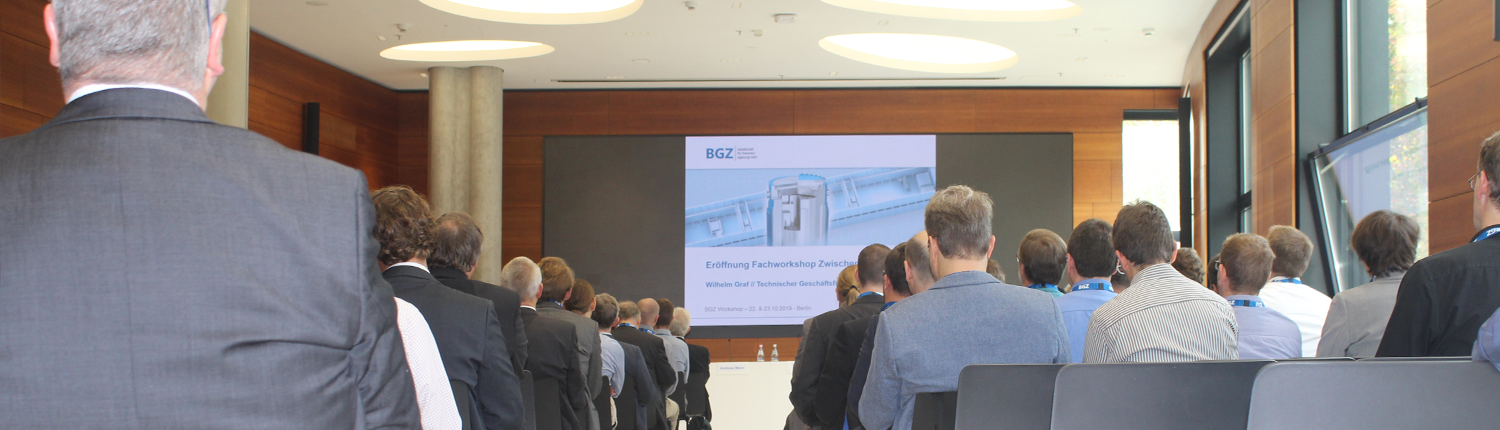
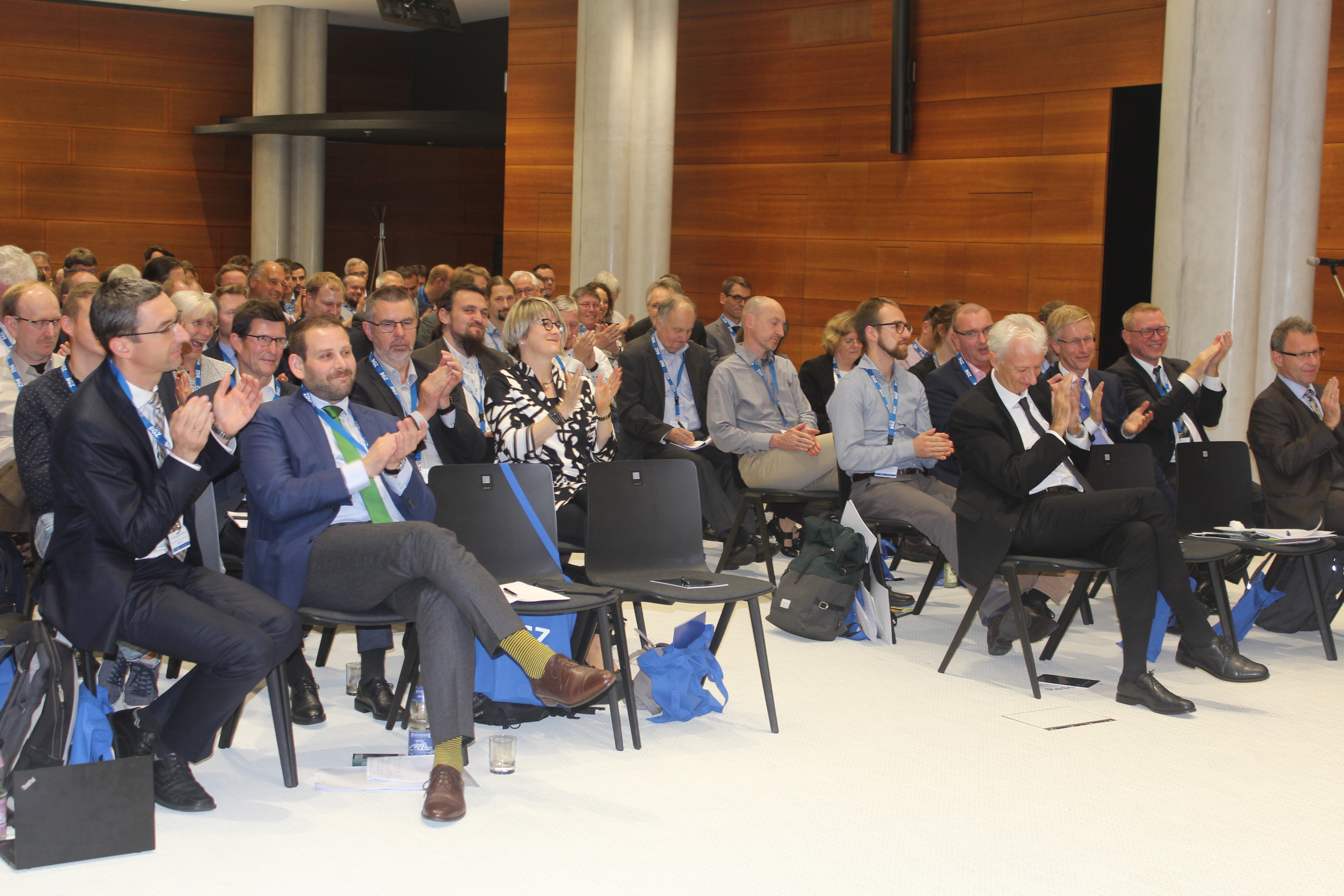
Am 22. und 23. Oktober 2019 fand in Berlin der erste Fachworkshop Zwischenlagerung der BGZ statt. Der Einladung zu dieser geplant zweijährlichen Veranstaltungsreihe folgten 101 Teilnehmer*innen aus Deutschland, sowie weitere Gäste aus dem Ausland. Der Teilnehmerkreis setzte sich aus Mitarbeiter*innen von Bundesministerien, Aufsichts- und Genehmigungsbehörden, Betreibern von Zwischenlagern, Energieversorgungsunternehmen, Universitäten, außeruniversitären Forschungseinrichtungen sowie Vertreter*innen weiterer Verbände und Bürgerinitiativen zusammen.

Im Rahmen von zehn Fachvorträgen wurden Forschungsthemen der verlängerten Zwischenlagerung dargestellt und fachlich diskutiert. Der Fachworkshop hatte das Ziel, offene Forschungsfragen zu identifizieren und zukünftige Aktionsfelder, die im Zusammenhang mit der Zwischenlagerung bestrahlter Brennelemente und wärmeentwickelnder Abfälle stehen, einzugrenzen und sie in die Belange der BGZ einzuordnen. Die vielschichtigen Aspekte der verlängerten Zwischenlagerung wurden im Nachgang bewertet und in die eigenen Überlegungen zum Forschungsprogramm der BGZ einbezogen.

BGZ stellt Weichen für verlängerte Zwischenlagerung radioaktiver Abfälle

Ende Oktober 2019 erörterten rund 100 Expert*innen aus Deutschland und der Schweiz auf Einladung der BGZ die wissenschaftlichen, technischen und genehmigungsrechtlichen Fragen, die mit einer verlängerten Aufbewahrung von hochradioaktiven Abfällen einhergehen. Im Nachgang zum Fachworkshop wurden die vielschichtigen Aspekte der verlängerten Zwischenlagerung bewertet und in die eigenen Überlegungen zum Forschungsprogramm der BGZ einbezogen.

Weiterlesen

BGZ stellt Forschungsprogramm vor

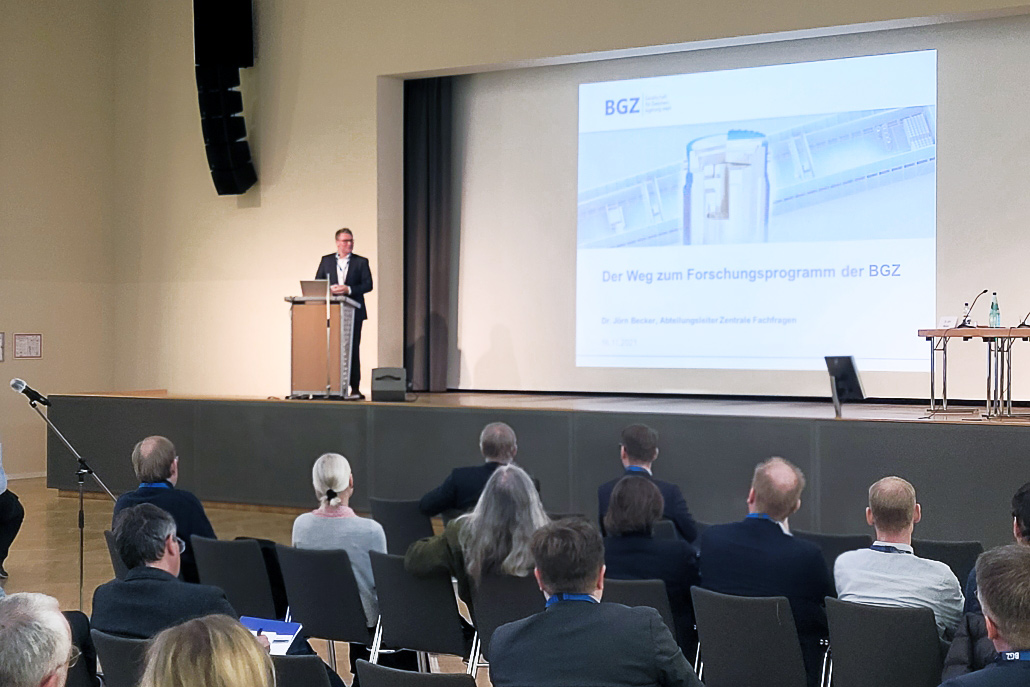
Die BGZ hat im Rahmen ihres zweiten Fachworkshops ihr Forschungsprogramm zur verlängerten Zwischenlagerung vorgestellt und dieses mit zahlreichen nationalen und internationalen Expert*innen erörtert. Am 16. und 17.11. diskutierten Expert*innen in Berlin auf Einladung der BGZ die wissenschaftlichen, technischen und genehmigungsrechtlichen Aspekte, die mit der notwendigen verlängerten Zwischenlagerung hochradioaktiver Abfällen einhergehen.

Wilhelm Graf freut sich als technischer Geschäftsführer der BGZ über die gute Resonanz: „Durch unser Forschungsprogramm sind wir einen großen Schritt vorangekommen mit unseren Vorbereitungen auf die verlängerte Zwischenlagerung.“ Graf weiter: „Unser Programm zeigt den Forschungsbedarf auf und gibt einen Überblick über unsere Forschungsstrategie sowie die diesbezüglichen Aktivitäten. Der Austausch dazu mit Expert*innen aus dem In- und Ausland wie bei unserem Fachworkshop ist für uns dabei elementar.“ Er machte auch deutlich, dass die BGZ das Forschungsprogramm laufend fortschreiben und an den sich weiterentwickelnden Stand von Wissenschaft und Technik anpassen werde.

Weiterlesen

Erster BGZ-Studierendentag: Akademischer Nachwuchs diskutiert über sichere Zwischenlagerung

Studierende aus Deutschland und der Schweiz haben sich erstmals auf Einladung der BGZ zum Austausch in Essen getroffen und erörterten dort ihre Abschlussarbeiten zur Zwischenlagerung radioaktiver Abfälle.

„Wir bieten damit ein neues, in dieser Art noch nicht vorhandenes Forum zum Austausch untereinander und fördern damit auch den Kompetenzerhalt in unserer Branche“, sagt Dr. Maik Stuke, Mitinitiator der Veranstaltung, aus der Abteilung Zentrale Fachfragen der BGZ. Das bundeseigene Unternehmen baut seine Aus- und Fortbildung kontinuierlich aus und führt diese mit ihrer eigenen Forschungsarbeit zusammen, um sicherzustellen, dass auch künftig qualifiziertes Fachpersonal und das wissenschaftliche Know-how vorhanden sind.

Weiterlesen

BGZ stellt Forschungsprogramm in Ahaus vor

In einer Informationsveranstaltung für den Rat und die Bürger*innen der Stadt Ahaus hat die BGZ ihr Forschungsprogramm zur verlängerten Zwischenlagerung vorgestellt. Das bundeseigene Unternehmen informierte außerdem zu aktuellen Vorhaben am Standort.

„Mit unserem Forschungsprogramm stellen wir die Weichen für eine verlängerte Zwischenlagerung an den 14 Standorten der BGZ mit Zwischenlagern für hochradioaktive Abfälle“, erklärte Dr. Jörn Becker, Leiter der für Forschung zuständigen Abteilung. Mit dem Programm habe die BGZ die Grundlage dafür erarbeitet, die Sicherheit der Zwischenlagerung auch über den bisher genehmigten Zeitraum von 40 Jahren nachzuweisen.

Weiterlesen

BGZ stellt Forschungsprogramm im Ausschuss Atomanlagen vor

Während einer öffentlichen Sitzung des Kreisausschusses Atomanlagen hat die BGZ ihr Forschungsprogramm zur verlängerten Zwischenlagerung vorgestellt. Das bundeseigene Unternehmen informierte außerdem über den Stand der vorgesehenen Nachrüstung des Zwischenlagers.

Weiterlesen

BGZ präsentiert Forschungsprogramm in Geesthacht

Die BGZ informierte gestern Bürgerinnen und Bürger im Ratssaal der Stadt Geesthacht über die notwendige verlängerte Zwischenlagerung hochradioaktiver Abfälle. Auf diese Aufgabe bereitet sich das bundeseigene Unternehmen mit einem eigenen Forschungsprogramm vor, das an dem Abend vorgestellt wurde.

Weiterlesen

Forum Zwischenlagerung: Reger Austausch über verlängerte Zwischenlagerung

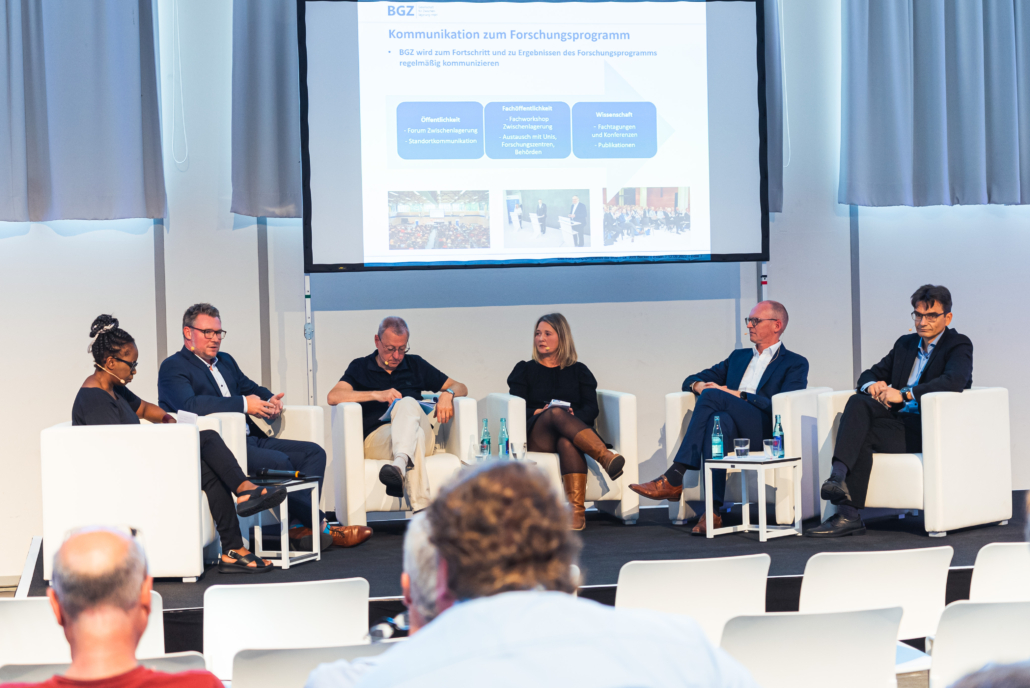
Auf Einladung der BGZ haben Expert*innen beim „Forum Zwischenlagerung“ über die notwendige verlängerte Zwischenlagerung diskutiert und die Fragen des Publikums, das vor Ort und per Livestream teilnahm, beantwortet.

Weiterlesen

BGZ informiert Nationales Begleitgremium über sichere Zwischenlagerung

Die BGZ hat bei einer Veranstaltung des Nationalen Begleitgremiums (NBG) in Ahaus ihre Aufgaben, die Vorbereitungen auf die notwendige verlängerte Zwischenlagerung sowie ihre Kommunikation mit der Bevölkerung erläutert. Die Mitglieder des NBG informierten sich bei einem Besuch des Zwischenlagers zudem über das Konzept der sicheren Zwischenlagerung.

Weiterlesen

Verlängerte Zwischenlagerung: BGZ stellt Forschungsprogramm in Brokdorf vor

Die BGZ informiert interessierte Bürgerinnen und Bürger im Rahmen eines öffentlichen Dialogabends in Brokdorf über ihre Vorbereitungen für die erforderliche verlängerte Zwischenlagerung hochradioaktiver Abfälle. Dazu möchte sie als Betreiberin des Zwischenlagers Brokdorf mit der Öffentlichkeit ins Gespräch kommen.

Weiterlesen

Zwischenlagerung radioaktiver Abfälle: BGZ stellt Mainbogen-Gemeinden Forschungsprogramm vor

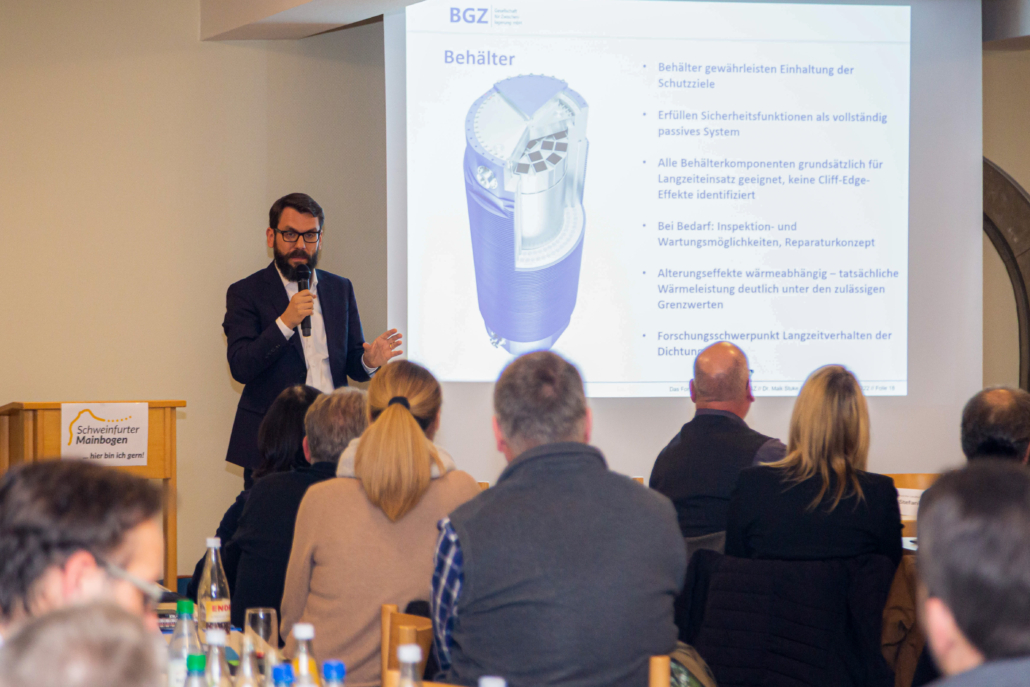
Die BGZ hat Vertreter*innen der sechs Gemeinden, die zur Allianz Schweinfurter Mainbogen gehören, ihr Forschungsprogramm zur verlängerten Zwischenlagerung vorgestellt. Das bundeseigene Unternehmen informierte außerdem über umfangreiche Investitionen am Standort Grafenrheinfeld.

Weiterlesen

Die BGZ informiert die Mitglieder des Kreistags Landshut über die sicherer Zwischenlagerung.

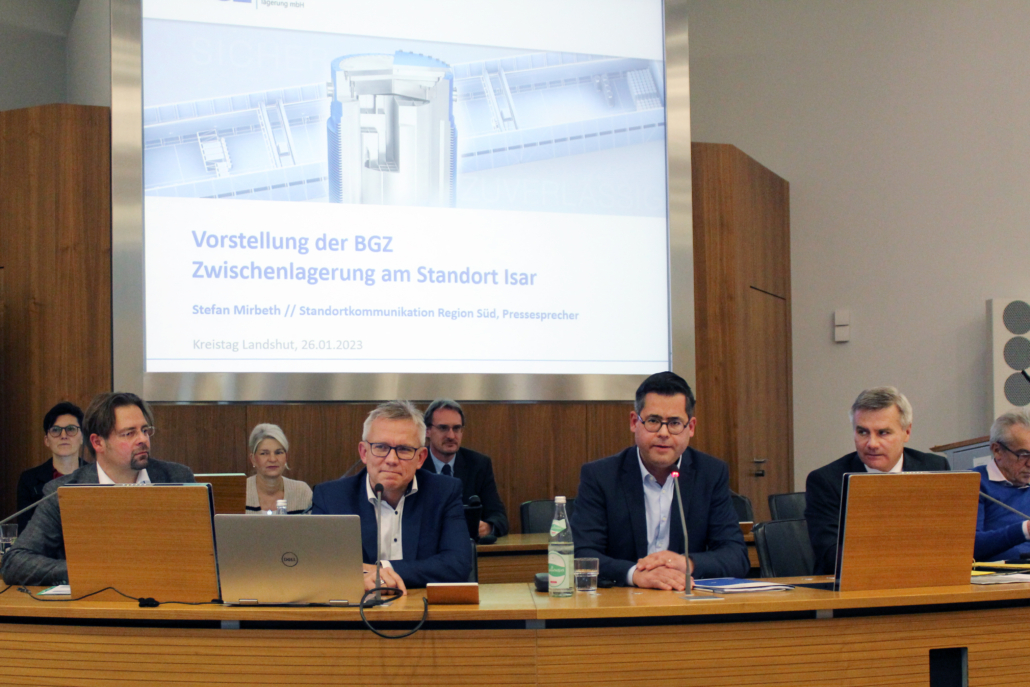
BGZ informiert Kreistag Landshut: Sichere Zwischenlagerung auch bei längerer Endlagersuche gewährleistet

Wie die BGZ die sichere Aufbewahrung der Behälter mit hochradioaktiven Abfällen bis zu deren Abgabe an ein Endlager gewährleistet, erläuterte das bundeseigene Unternehmen jüngst dem Landshuter Kreistag.

Weiterlesen

BGZ informiert in Dannenberg: Sichere Zwischenlagerung auch bei längerer Endlagersuche gewährleistet

Wie die BGZ die sichere Aufbewahrung von hochradioaktiven Abfällen bis zu deren Abgabe an ein Endlager gewährleistet, erläuterte das bundeseigene Unternehmen jüngst bei einer Informationsveranstaltung der Bürgerinitiative Lüchow Dannenberg.

Weiterlesen

Aks your question … about our research activities